⏰Got 3 minutes?
|
Most people think a Tarot spread organizes the cards. I think it organizes your attention. It’s less like a layout... and more like an AI prompt. The spread tells the reading what kind of answer you’re looking for.
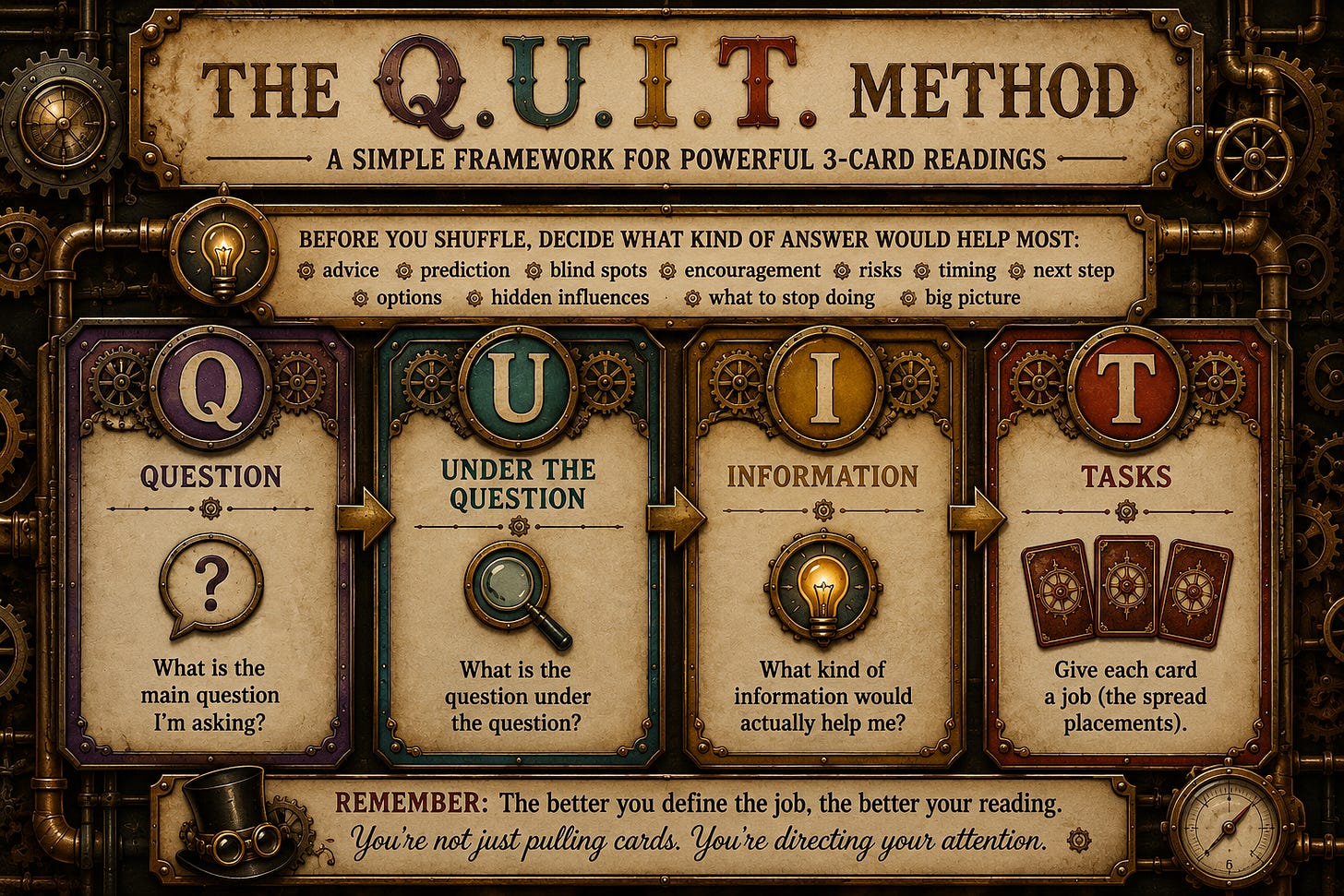
What kind of information would actually help me?Many folks ask a question, slap down a few cards and hope for the best. That’s like when someone plops down in the chair in front of me at a party or event and says, “Tell me stuff.” Yes, occasionally people do that. Do you go to Google and type “tell me stuff”? When the doctor says, “Tell me what the problem is”, Okay I’m being very sarcastic, but you get the point. The QUIT method guides you to crafting a spread that reveals insights instead of slap dash card reading. The Process:Before you even shuffle, decide what kind of insight would be most helpful:
Each answer creates a different spread. The QUIT methodQ - question U- question under the question I - information (see bullet points above) T- tasks (give each card a job) Notice we haven’t even shuffled cards yet. Examples:Q: Is he cheating? U: What do I do if he is cheating? I: my options and next steps T: his actions - blind spots - next step His actions answer the literal question “is he cheating?”. Blind spots help me see maybe why this happened or something I’m not seeing about the situation. Next steps give advice on what to do if he is cheating, whether the answer is yes or no. Q: Am I on the right path? U: Will my efforts yield the results I desire? I: analysis of what I’m doing to achieve the result T: the path - keep doing - stop doing The path shows the general trajectory. Keep doing shows what is in alignment and what to continue. Stop doing shows the opposite. Q: Why am I stuck? U: What fear or story am I buying into? I: perspective shift or reframe T: apparent block - real block - the opening Apparent block describes what appears to be the problem. Real block is the fear or story at play. The opening is the perspective shift to clear the block. Once you realize a spread is really just a way of directing your attention-
You stop collecting spreads and start designing them.
That’s exactly what we’ll be practicing in my upcoming workshop
-Cassandra the Card Reader |